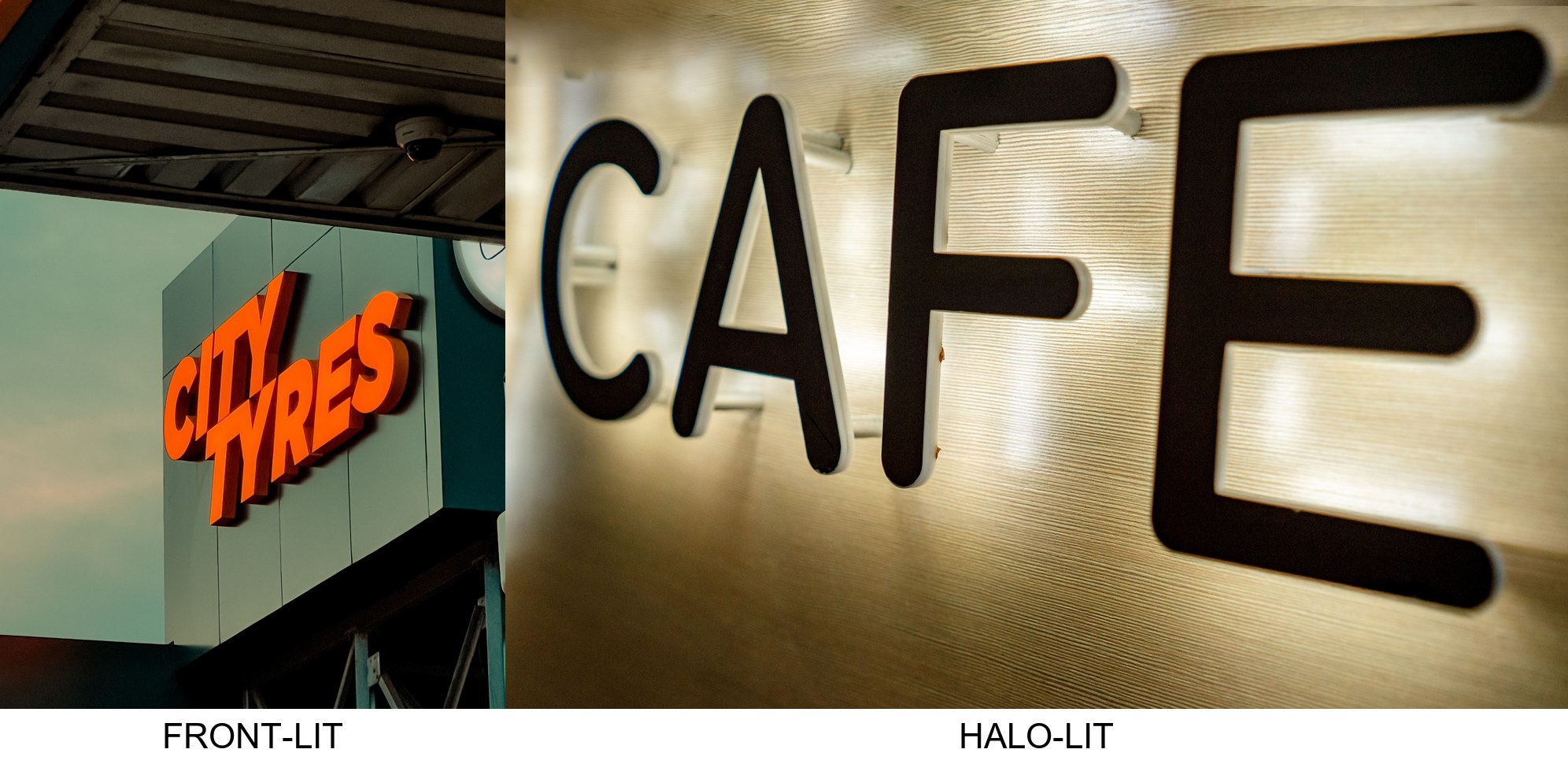
Front-lit channel letters shine forward through a translucent acrylic face for maximum visibility — halo-lit letters shine backward onto the wall for a premium outline glow — and the right choice comes down to brand tone, wall surface, and roughly a 20–30% cost difference. Front-lit wins on brightness and price per letter; halo-lit wins on elegance and upscale positioning. Many high-end facades combine both.
This comparison breaks down the two lighting styles across appearance, cost, maintenance, wall requirements, and the businesses each one fits — with a side-by-side photo checklist you can use to judge the difference on real buildings, not just renders.
What Is a Front-Lit (Face-Lit) Channel Letter?
A front-lit channel letter — also called a face-lit or standard illuminated letter — is the classic lighted storefront letter: an aluminum return (the letter’s side wall), LED modules inside, and a translucent acrylic face that light shines straight through toward the street.
Key characteristics:
- Light direction: forward, out of the face
- Daytime look: colored acrylic faces, clean and familiar
- Nighttime look: fully illuminated letterforms — the entire letter glows
- Brightness: the brightest option per watt; readable from the greatest distance
- Best for: retail, restaurants/QSR, any business whose sign needs to compete for attention
Because the acrylic face does the “glowing,” front-lit letters are forgiving to engineer: module placement is calculated for even face illumination, and any hot-spot issues are fixable by adjusting module density — a mature, well-understood process at any competent factory.
What Is a Halo-Lit (Reverse-Lit) Channel Letter?
A halo-lit channel letter — also called a reverse-lit or back-lit letter — flips the design: the face is solid aluminum (painted to match the building or the brand), and LED modules are aimed backward, washing light onto the wall behind each letter. At night, each letterform appears as a soft glowing outline floating off the wall.
Key characteristics:
- Light direction: backward, onto the mounting surface
- Daytime look: sleek metal letterforms — many premium brands prefer this minimal look even before the lights come on
- Nighttime look: a warm or cool halo tracing each letter’s edge — subtle, architectural, expensive-looking
- Brightness: lower than front-lit by design; this is mood, not megaphone
- Best for: law firms, hotels, medical offices, boutique retail, corporate HQs
The engineering is less forgiving than front-lit. The halo effect lives or dies on three things: a consistent standoff distance from the wall (typically ~1–1.5 inches), sealed light-tight construction so light escapes only at the back, and a calculated module layout so the halo is even rather than blotchy. A poorly built halo letter shows dark spots and uneven glow from the sidewalk — which is why you should always see a sample before committing a full set.
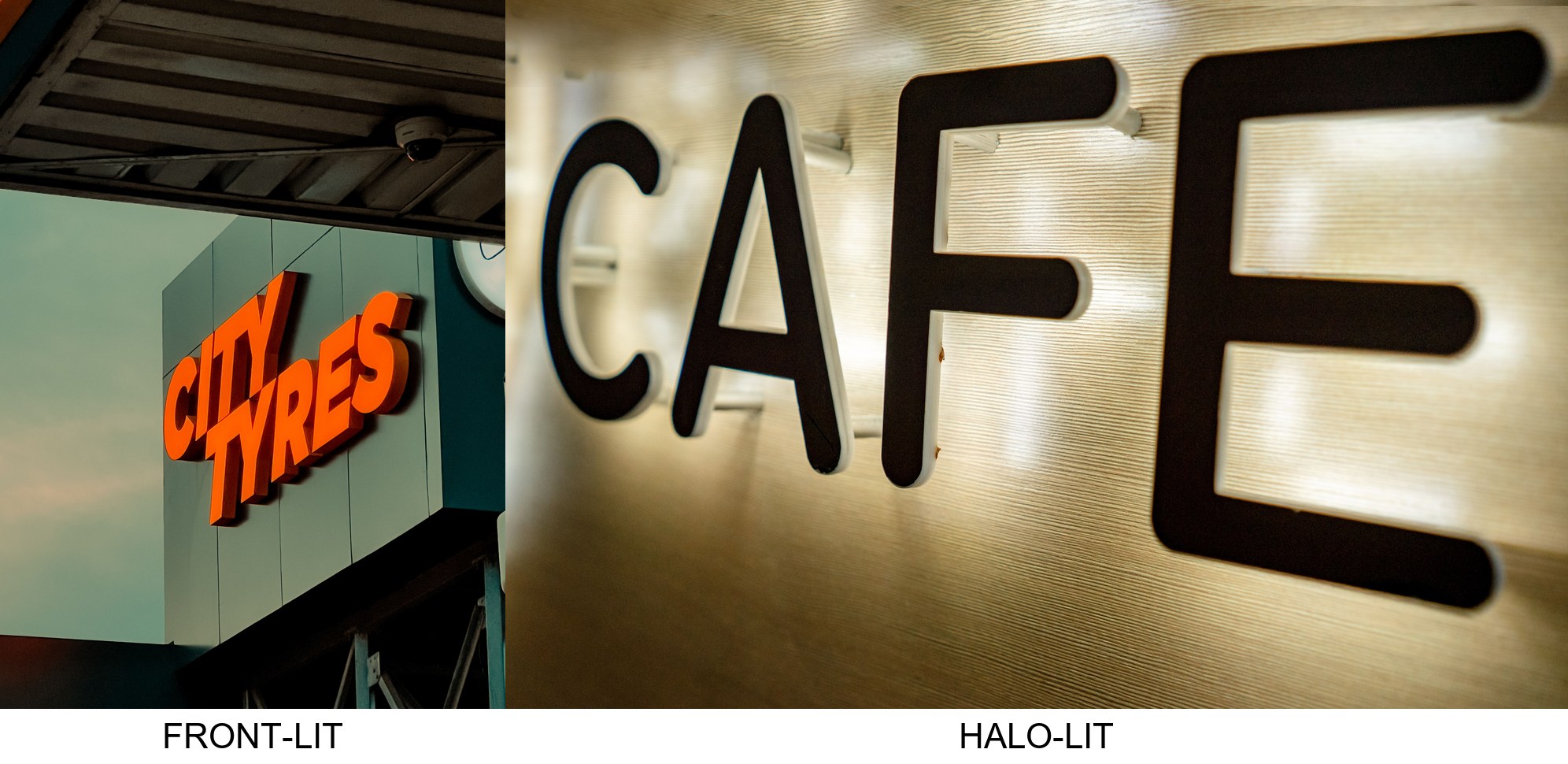
Image: composite comparison built from two licensed photos (组合图) — left “FRONT-LIT”: Pexels #38964894 (front-lit letters at dusk), right “HALO-LIT”: Pexels #12944739 (halo-lit letters glowing from behind). Both Pexels License, free for commercial use. Photos: https://www.pexels.com/photo/38964894/ , https://www.pexels.com/photo/12944739/
Front Lit vs Halo Lit: Core Comparison Table
| Dimension | Front-Lit (Face-Lit) | Halo-Lit (Reverse-Lit) |
|---|---|---|
| Light direction | Forward through translucent acrylic face | Backward onto the wall behind |
| Night appearance | Fully glowing letterforms; high visibility | Soft outline glow; architectural, understated |
| Day appearance | Colored acrylic faces | Sleek solid-metal letterforms |
| Brightness / visibility | Highest; readable from far down the road | Lower; ambient halo, best up close |
| Relative cost (factory-direct) | Baseline (~$20–$80/letter typical factory range) | +20–30% (~$35–$120/letter typical factory range) |
| Why it costs that | Simpler face material, standard module layout | Aluminum face, sealed returns, standoff hardware, careful LED calc |
| Maintenance | Occasional face cleaning; module replacement through the face | Face never needs polish; wall behind letter shows dust rings over years; module access via removable back |
| Wall requirements | Works on nearly any facade | Needs a smooth, light-colored wall — the halo reflects off the wall itself |
| Brand tone | Bold, energetic, attention-first | Premium, quiet confidence, design-led |
| Best-fit businesses | QSR, retail, gas stations, strip-mall shops | Law firms, hotels, med spas, dental/medical, corporate offices |
Price ranges are typical factory-direct figures surveyed from Chinese signage manufacturers in October 2026 (competitor-published data); all final pricing is subject to Folomei’s official quotation — Folomei issues firm itemized quotes within 24 hours.
The Cost Difference, Explained: Why Halo-Lit Runs 20–30% Higher
The premium isn’t a “luxury tax” — it’s traceable to three build differences:
-
No cheap glowing face. A front-lit letter’s most visible component is a translucent acrylic face; a halo letter replaces it with a formed and painted aluminum face — more material, more finishing, tighter tolerances so light doesn’t leak around the edges.
-
Sealed light-tight construction. Halo letters must contain all their light except what exits the back. That means welded or seamed returns with light-blocking treatment inside — labor the front-lit letter doesn’t need.
-
Standoff hardware and layout engineering. Each letter mounts on spacers that hold a precise gap off the wall, and the LED modules inside are positioned per a layout calculation so the halo on the wall is even. Folomei ships a standoff layout drawing with every halo order so your installer sets each mounting point to spec on the first pass — no re-drilling a client’s brick facade.
Worth noting: the 20–30% premium applies at the factory level. In a U.S. local-shop quote, halo-lit often carries an even larger premium because the precision mounting is more installer-hours. The factory-direct route compresses that difference.
Which Should Your Business Choose? A Quick Guide by Industry
Restaurants & QSR → Front-Lit (usually)
Fast food lives and dies by drive-by recognition. A fully glowing red-and-yellow letterform is visible from hundreds of feet at night and reads instantly against the visual noise of a commercial strip. QSR brand standards almost universally specify front-lit letters. Exception: an upscale wine bar, craft cocktail room, or fine-dining room on a quiet street — that’s halo territory, where the sign whispers “evening” instead of shouting “open.”
Law Firms, Accounting & Professional Offices → Halo-Lit
Professional services sell trust and restraint. A softly glowing outline on a stone or dark-metal facade reads as established and expensive — exactly the client’s first impression. Front-lit acrylic faces in primary colors would undercut the positioning. If the office is in a multi-tenant building with strict signage codes, halo-lit letters are also more likely to pass design review.
Retail → Front-Lit (with one exception)
Stores need to be found. Front-lit letters maximize legibility from the parking lot and the road, which is what converts drive-bys into walk-ins. The exception: boutique and luxury retail, where the brand is deliberately understated — halo-lit letters on a clean white or dark storefront signal premium the way unbranded packaging does.
Medical, Dental & Wellness Clinics → Halo-Lit (or a combo)
Clinics want calm and cleanliness. A halo glow on a light-toned facade reads modern and spa-like; glowing acrylic faces read more like retail. Medical buildings on busy roads sometimes use front-lit letters on the road-facing sign while the entrance-level suite gets halo-lit letters — tiering visibility by distance.
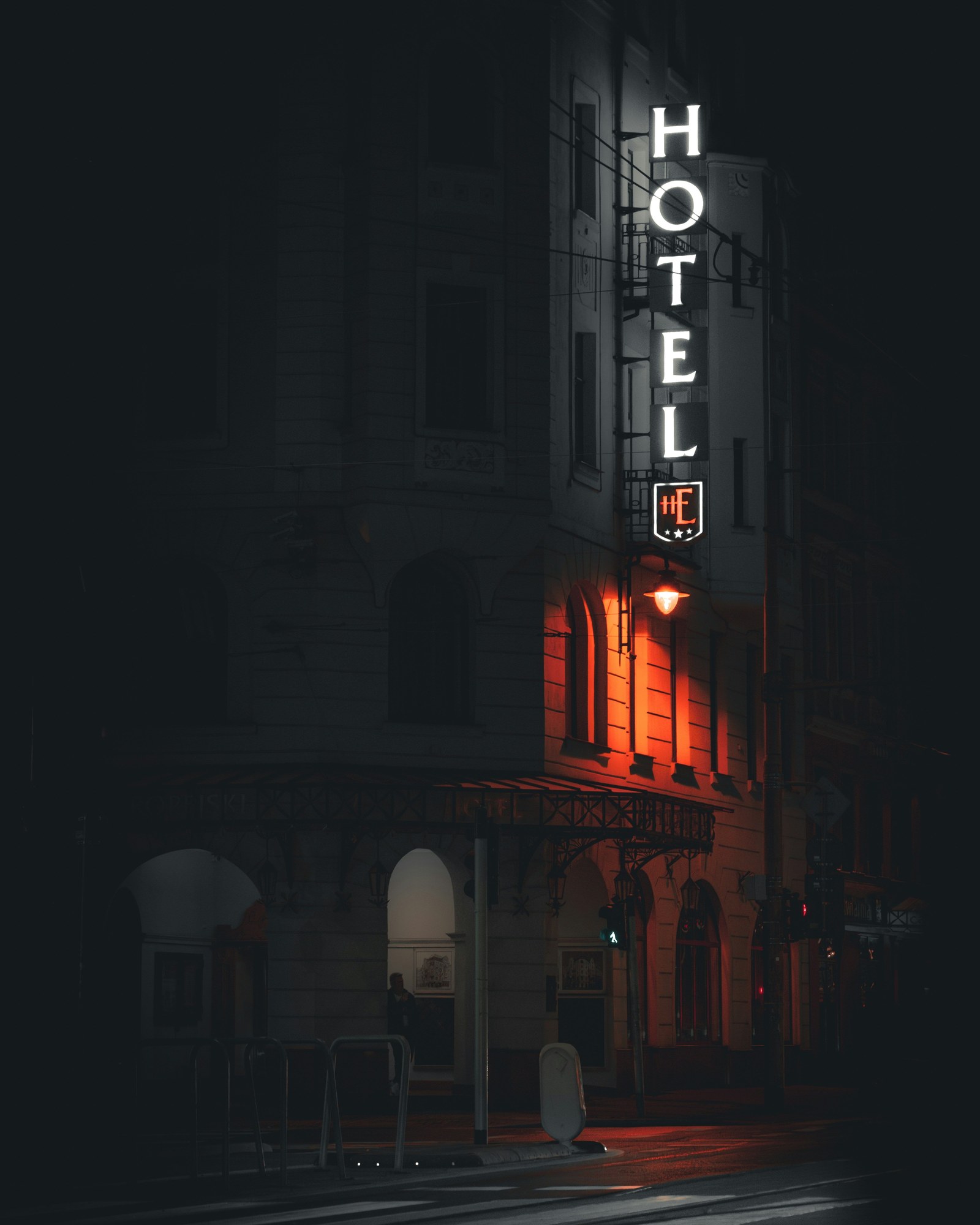
Image: illuminated hotel letters on a building facade at night (illustrative) — Pexels #35757436, Pexels License (free for commercial use). Photo: https://www.pexels.com/photo/35757436/
The Detail Most Guides Skip: Your Wall Decides More Than Your Budget
Halo-lit letters don’t glow on their own — the wall is half the fixture. The light washes backward and reflects off the mounting surface, so:
- Light, smooth walls (white stucco, light brick, light stone, painted CMU) produce the brightest, most even halo.
- Dark walls swallow the light; you’ll need higher-output modules (more cost) and the effect still reads subtler.
- Rough, textured walls (split-face block, heavily textured stucco) scatter the halo and can look blotchy — front-lit is usually the safer call.
- Standoff distance matters: too close and the halo is a thin hard line; too far and the letters look like they’re floating unattached. ~1–1.5 inches is the standard engineered gap, set per the layout drawing.
Front-lit letters have no such constraint — the face glows regardless of wall color or texture — which is one more reason they dominate strip-mall and roadside applications.
Can You Combine Both? Yes — Front + Halo Combo Letters
The premium option on the menu: letters with a translucent front face and backward halo illumination, giving you full letterform glow at night plus the floating outline effect. It’s the most expensive build type, but it solves a real problem — facades that need presence from a distance and elegance up close (hotels, flagship retail, medical campus entrances).
By day, combo letters look like crisp metal letters with subtle acrylic accents. By night, they’re fully lit from within and haloed behind. If your client is torn between the two styles, this is usually what ends the argument — at roughly the top of the factory price range (quote required per design).
Installation & Maintenance Differences Worth Knowing Before You Order
The two styles also differ in what happens after the shipment lands:
- Installation labor. Front-lit letters on a raceway arrive pre-wired and hang as one unit — the fastest, cheapest install in the sign business. Halo-lit letters mount individually on standoffs, each set to the layout drawing, which takes more installer hours and rewards a careful crew.
- Cleaning. Front-lit acrylic faces attract dust and need occasional cleaning to stay bright; halo-lit faces are paint, not acrylic, so they stay crisp — but the wall behind halo letters collects a visible dust ring over the years (the halo lights it up), and periodic wall cleaning keeps the effect even.
- Service access. Both types are serviceable in place: modules are reachable through the removable face (front-lit) or back tray (halo-lit). Power supplies are the first component to fail in either style, and both are modular drop-in replacements — no re-fabrication required.
None of these differences changes the ranking; they just explain why the halo premium extends beyond the factory invoice into the install.
FAQ: Front Lit vs. Halo Lit, Answered Straight
Which is brighter, front-lit or halo-lit channel letters?
Front-lit is significantly brighter. The entire letterface glows and is legible from far down the road; halo-lit produces only an outline glow on the wall and is designed for ambiance at close range. For maximum roadside visibility, choose front-lit.
Which costs more, front-lit or halo-lit?
Halo-lit typically costs 20–30% more factory-direct (typical factory ranges: ~$20–$80/letter front-lit vs. ~$35–$120/letter halo-lit; final pricing subject to Folomei’s official quotation) because of the aluminum face, sealed light-tight returns, and standoff hardware. Local-shop quotes often show an even wider halo premium.
Can you combine front-lit and halo-lit in the same letters?
Yes. Combination letters use a translucent front face plus rear-facing modules, producing both a glowing letterform and a wall halo. They sit at the top of the price range and are common on hotels, flagship stores, and medical campuses.
Do halo-lit letters work on a dark wall?
They work, but poorly on very dark or textured surfaces — the halo reflects off the wall itself, so dark and rough walls mute or scatter the effect. On a dark facade, expect to specify higher-output modules, or choose front-lit letters instead.
Which style lasts longer?
Lifespans are comparable — a well-built set of either type with quality LED modules runs 8–15 years. Halo-lit’s solid aluminum face never yellows or fades the way an acrylic face can over many years of UV, but front-lit faces are inexpensive to replace if needed. In practice, power supplies and modules fail before either face does — and both are modular, inexpensive replacements.
See Your Facade Both Ways — Free
Still deciding? Don’t choose from a spec sheet. Send Folomei Signs your logo and we’ll produce a free 3D mockup of your letters in front-lit and halo-lit versions on your actual facade — plus a firm, itemized quote within 24 hours, DDP-delivered to the U.S. or Canada with UL/ETL certified LED modules and power supplies as standard.
- Front-lit built to your spec: Channel Letters — front-lit product page
- Halo-lit with standoff engineering drawings included: Halo-Lit Channel Letters product page
Get your free 3D mockup and 24-hour quote →
Related reading: How Much Do Channel Letters Cost in 2026? · Channel Letters product page
Leave a Reply